Avatar: The Last Airbender, the cost of sacrificing story for spectacle, when nostalgia becomes neglect, and how big budgets can never overrule a great script.

There has been a trend in recent years, known to many both in- and outside the media and entertainment industry: the rise of remakes. In some cases, it feels as though the only films and series that are being produced are just old stories being rebooted into something “new”. This has perhaps even become a frustration for many avid moviegoers, who want to be blown away by a great story, but quickly realize that their favorite Disney film growing up has now been remade into a live-action disaster.
But why are these films lesser?
How can they be so bad, considering the budgets that are thrown at them?
What is going on?
Without going too much into the reasoning behind why studios are investing in remakes and reboots, I want to analyze why they are in fact so terrible, based on one of my favorite series of all time — Avatar: The Last Airbender. As a kid, I was an avid Avatar fan, with a collection of all three seasons in a DVD box set, and as an adult, I rewatched this show multiple times. Needless to say, I was both thrilled and terrified when I found out that Netflix had planned to release a live-action adaptation of this animated fantasy action series.

Sidenote: the animated series Avatar is often confused with the Avatar films — a science-fiction franchise with blue people — though both are completely different.
THE SERIES
Avatar: The Last Airbender is set in a world where humans are divided into four nations — the Water Tribe, the Earth Kingdom, the Fire Nation, and the Air Nomads. In each nation, there are certain people called “benders”, who are able to manipulate and control the natural element of their nation. In the Water Tribe benders can move water, in the Fire Nation benders are able to control fire, etc.
In the series, we meet Katara and Sokka, two teenage siblings of the Southern Water Tribe. During their travels, they accidentally find and awaken Aang — the long-lost Avatar — who has been trapped in a century-long wintersleep. The Avatar is a strong being who can (learn to) bend all four elements, and whose duty it is to maintain harmony between the four nations, as well as act as the link between the human and spirit world.

A hundred years earlier, the ruler of the Fire Nation started a world war in order to expand his nation's empire. Realizing that the new Avatar must be an Air Nomad, he decided to carry out a genocide against the Air Nomads to kill the Avatar. What he did not know was that right before te war, the Avatar — twelve year old Aang — had run away from home, as he was afraid of his Avatar responsibilities and wanted to flee.
After Katara and Sokka revive Aang, the three of them go on a journey, where Aang learns how to bend all four elements, in order to defeat the Fire Nation and fulfill his duty of bringing harmony to the four nations.
ANIMATION VS. LIVE-ACTION
An important aspect of storytelling is that films should feel truthful. Stories can never be as realistic as real life, but there is a certain “believability” present in every strong work of fiction. No matter what kind of world writers create, they must stick to the rules of that world. This consistency builds trust between storyteller and audience, as we learn how the world works and can immerse ourselves in it. In other words: verisimilitude — when something feels emotionally truthful, even if it is not realistic.

In cartoons or animation, storytellers can get away with far more, seeing as exaggerated character movements and create absurd situations that still feel truthful. It does not matter that Bugs Bunny defies the laws of gravity, or that Tom’s eyes fall out of his skull when chasing Jerry — these characters simply live by different rules of physics and anatomy. When Bugs walks off a cliff, he hangs in the air and only falls once he notices it. When Tom’s eyes fall out of his head, they eventually snap back into place.
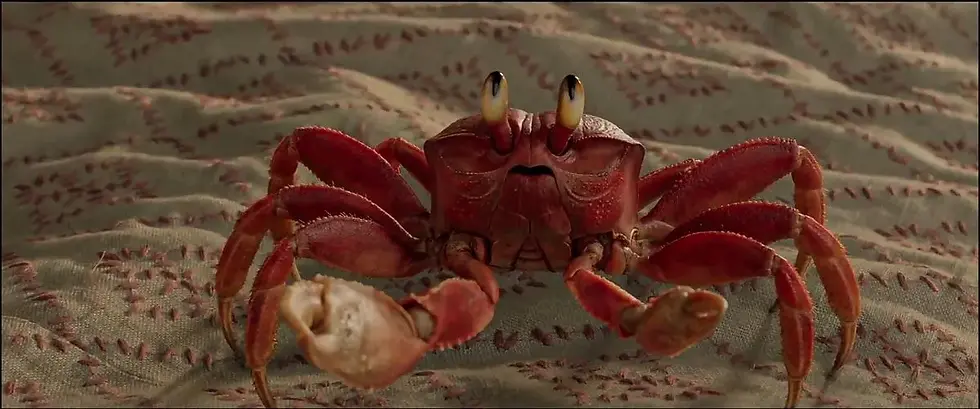
A reason why live-action adaptations might fail is that they use the rules of animation, without the freedom that cartoons permit. A talking crab does not feel strange in The Little Mermaid: he looks similar to the rest of the characters in this world, his eyes convey emotion, and his body is flexible. In the live-action version, however, we are presented with a figure that looks and moves like a real crab, and he’s talking. That’s not cute, it’s unsettling.
In all honesty, I was pleasantly surprised with the VFX work in the Avatar live-action adaptation, as well as the creative visual choices. It appears that a large part of the budget went into visual effects, and it paid off. The bending of the elements looks convincing, the landscapes are visually stunning, and many of the fantastical elements feel photo-real. So this — which usually goes wrong in live-action remakes — is not the main reason why this series performed so poorly compared to its animated counterpart.
STORY ELEMENTS
An adaptation can never be exactly the same as its original, which is why I am not arguing that the live-action Avatar — or any other live-action adaptation for that matter — needs to replicate the original. When adapting a story from one medium to another, one cannot expect the exact same experience. Therefore, I do not judge this reboot based on whether it feels identical. Instead, my analysis will be based solely on how the story functions as a whole, in comparison to the original animated series.
THE OPENING
The animated series (2005-2008) opens on a strong note, introducing Katara — attempting to waterbend — and her brother Sokka, who constantly belittles her efforts. This frustrates Katara so much that she accidentally breaks open an iceberg, the one in which Aang has been trapped for a hundred years. The noise alerts a nearby Fire Nation ship, forcing the siblings and Aang to flee together.

On that ship, we meet two crucial characters: Zuko — the banished son of the Fire Lord, tasked with capturing the Avatar — and his uncle Iroh. This is an effective opening, as we are immediately introduced to the main players and their flaws. Katara struggles with anger and being taken seriously, especially by her immature and sexist older brother.
As the trio travels together, Katara and Sokka keep an important secret from Aang. He speaks fondly of his life with the Air Nomads and his mentor, Monk Gyatso, though Aang is completely unaware that his entire people are dead. Katara and Sokka cannot bring themselves to tell him, so they distract him and try to keep his spirits up.
When they arrive at Aang’s former home, the truth reveals itself. Aang learns that his entire nation has been wiped out. His friends, his mentor, everyone. Overwhelmed, he enters the Avatar State, a powerful defensive reaction. Katara ultimately calms him, cementing an emotional bond that becomes foundational to their relationship.

The live-action series (2024) opens very differently. Instead of being introduced to our two main characters, Katara and Sokka, the series starts with an intense fight scene showing how ruthless the Fire Nation is, as they brutally kill someone by burning him alive. Right after this scene, which takes place in the past, we meet the Air Nomads who do not know what is about to happen to them. Aang learns that he is the Avatar and wants some fresh air to process this information, and while he is gone the Fire Nation kill the Air Nomads.
There are a variety of reasons why this opening does not work. First, it spends far too much time in the past, unloading information before we’ve emotionally connected to anyone. The animated series reveals its world gradually, allowing curiosity to build. The live-action version instead explains everything immediately. Second, Aang’s characterization suffers. In the animated series, we meet an energetic, distracted child. In the live-action version, Aang is serious and introspective from the start. His defining traits are stated through dialogue rather than demonstrated. When he says, “I like to play airball and eat banana cakes and goof off with my friends,” it feels like exposition rather than lived behavior. Talking the talk, but not walking the walk.

Twenty minutes into the episode, we finally meet Katara and Sokka, the siblings whose dynamic has been flattened. Sokka is more reasonable, Katara more subdued. The Fire Nation ship arrives without urgency. Aang learns about the genocide through a long monologue by an elderly woman. When he later sees the ruins of his home, the emotional impact is diminished because the revelation has already occurred. His Avatar State feels like an overreaction, and Katara is no longer the one to ground him instead, his mentor Gyatso’s memory does. A key emotional foundation is replaced by a relationship with a character who no longer exists in the present story.
CHARACTERS
Twelve-year old boy, Aang, is the last living Airbender. In the animation series, he is just a little kid who has been given this overwhelming responsibility of changing the world. He becomes scared, so much so that Aang ends up running away, fleeing his responsibilities, and the guilt of having left his nation behind, is something that follows him throughout the series. We see Aang as a whimsy boy who is rarely focused on the task at hand, always wanting to go on side quests, and getting distracted by things that appear more fun to him then saving the world.

In the live-action series, Aang is serious and focused. The character speaks about wanting to have fun, but we never actually see him getting distracted and he is, in fact, always focused on the task at hand.
Katara, the only waterbender of the Southern Water Tribe, had to become an adult very quickly. At a young age, her mother was killed by the Fire Nation and her father fled to war, which meant Katara felt great responsibility of filling her mother’s role. She’s kind, compassionate, and very protective of those around her, which makes her a motherly figure to those she’s traveling with. Still, Katara wishes to become a better waterbender and has to work twice as hard as Aang to get there. She grapples with a temper, fueled by feelings of inadequacy.
In the first season, Katara’s goal is to get to the Northern Water Tribe in order to be taught waterbending, something she never had access to. Only, when she gets there, she finds out that women are not allowed to train.

In the live-action series, Katara is already great at waterbending. She does not even have to try hard, which makes her character arc practically nonexistent. By making Katara a more “powerful” female character, they basically stripped away any of the depth she had in the animation series, where she was forced to work twice as hard, dealing with the anger and frustration of not being taken seriously. When she surpasses Aang in waterbending abilities, this feels like an incredible hard-earned achievement. Instead, live-action Katara’s entire personality is based on her incredible waterbending abilities. No conflict, no struggle, no pay-off.
Sokka is known for being loyal and sharp-witted, though somewhat abrasive and immature. We get to know him as an overly confident and misguided teenage boy. When his father left for war, Sokka felt an immense responsibility to take over his role in the family. He believes that only men are able to defeat the Fire Nation, does not taking his sister Katara seriously even though she is the one with waterbending abilities, and not him.

In the live-action series, the writers decided to take away Sokka’s sexist remarks and belittling behavior, thus completely changing his personality and taking away his main flaws. The reason why is unclear to me, though my guess is that they felt that this way if speaking is not appropriate to a modern audience. However, presenting a character with certain beliefs does not necessarily entail that the show is glorifying this behavior. In the animated series, Sokka makes certain remarks, though he is always put in his place. He belittles the female earthbenders, after which he is taken down by one of them, Suki, who he later even apologizes to. That completely changes in the live-action series, where Suki is — for some reason — unable to train, seeing as she is so distracted by the handsome Sokka. By trying to remove sexism from the show, the show made itself more sexist in its execution.
Lastly, we follow the character Zuko who is the son of Ozai, the Fire Lord. When speaking out of turn at a war meeting, disrespecting all those attending, Zuko is challenged to a fire duel. Zuko accepts this, thinking he will be fighting the general, only to figure out he actually has to have a duel with his father. Zuko begs his father not to have to fight him, which makes Ozai even more angry with his son, burning his face and banishing him from the Fire Nation. Zuko is sent on a quest with his uncle to find the Avatar, and cannot return home until he does so.

In the live-action series, Zuko does end up fighting his dad — the all powerful Fire Lord — and is able to win, but Zuko decides to stop fighting right before he is able to hurt him. Not only does that completely undermine Ozai — the almighty Fire Lord and great antagonist in the series — his powers, but it also defeats the purpose of Zuko’s character. By begging not to fight his father in the animated series, Zuko shows us a side to him which is completely different to his father. He does not want to hurt those he loves. And when he ends up fighting his father at the end for the greater good, it makes his journey so much more meaningful.

EXPOSITION
In storytelling there is the famous “show, don’t tell” principle, which implies that characters will show us how they are feeling instead of writers having to tell us. Audiences are not stupid. They can — either consciously or subconciously — understand subext and even generate meaning from it. In fact, I believe audience like not knowing everything, seeing as that mystery sparks a curiosity that makes them want to keep on watching.
Unfortunately, the live-action Avatar series rarely abides by the “show, don’t tell” principle. There is a lot of expository dialogue, telling us exactly what characters are feeling. Furthermore, a huge chunk information — which the animated series shows us slowly throughout the entire story — the live-action reveals to us almost immediately. Not only that, this information is repeated multiple times, meaning the storytellers believe the audience to have to hear it multiple times in order to understand what is happening. This not only undermines the audience, it undermines the importance of setting things up so that a story can evolve organically.
MISSING THE POINT
Many might blame remakes, reboots, and adaptions for trying too hard to be like the original and not succeeding due to various factors, such as lack of originality, underwhelming visual effects, or miscasting main characters. These are all valid reasons, though I do not believe they are the main cause of the failure of these films and shows. As seen with the live-action adaptation of Avatar: The Last Airbender, many of the issues did not arise with visuals, or even — in my opinion — casting. The main problem with the show was that the story and characters were taken for granted.

In the original series the writers, Michael Dante DiMartino and Bryan Konietzko, carefully crafted a world, where each character had their own flaws making them both imperfect and relatable. Over three seasons, they allowed these characters to learn and grow, struggling and working hard towards becoming the best versions of themselves. Meanwhile, the story had enough breathing room to develop with the writers only revealing things part by part, letting the story unfold by itself.
Many remakes, reboots and adaptations try to jump into the story far too quickly, trying to tell us the information instead of weaving it into a well thought-out narrative. Thus the problem is not simply visuals, casting, or lack of creativity. It’s the negligence of the most important aspect of what makes us engage with a story — the story itself. Not VFX and fight sequences, but characters, what they live through and how they are living through it.
Story is where the money is.


